
You may be asking, “Is sound dampening right for your basement ceiling?” Yes, it is, as unmitigated noise upstairs can make staying in the basement for an extended period unbearable.
In a nutshell, here at Creative Construction Solutions, we offer (3) levels of sound dampening. Think Good, Better, and Best.
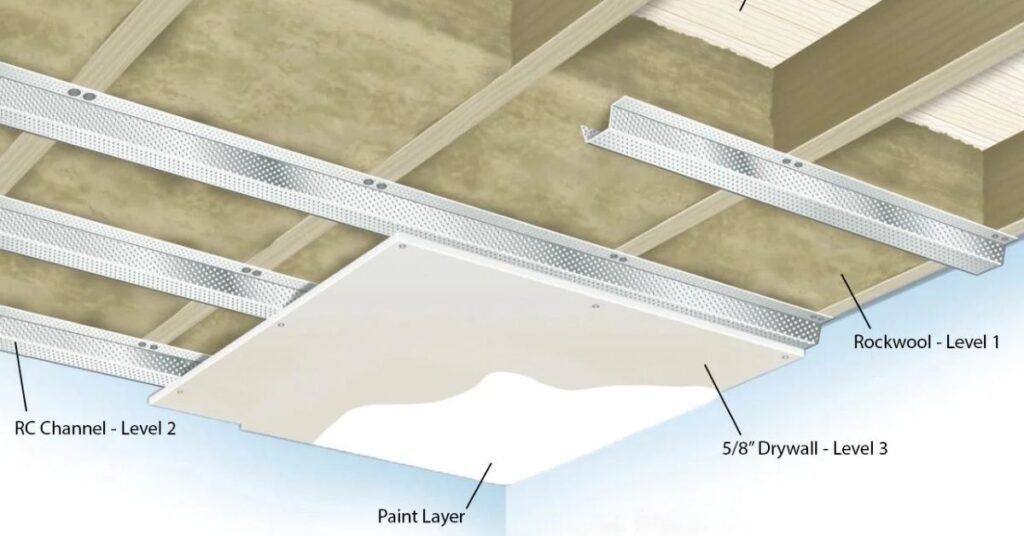
It’s important to note for the below material to be effective, they need to be installed on top of each other – level 2 sound dampening is a combination of level 1 sound PLUS level 2. And level 3 sound dampening is a combination of level 1, 2 and 3.
What is CCS’s Good/Level 1 option?
Our level 1 sound dampening insulation is a product call Rockwool. More specifically, Safe N’ Sound Rockwool. The main purpose of this insulation is to block sound. When comparing standard insulation (think; walls and attic insulation) to Rockwool, you’ll notice that standard insulation kind of looks and feels like cotton candy (I don’t suggest feeling the insulation, but if you ever have, you know what I’m talking about).
Rockwool on the other hand is much denser. If you were to take a piece of rockwool and compress it between your hands, it’s similar to trying to compress something like a piece of packing foam. It’s a dense product and it does a great job at sound mitigation.
How much can I expect to pay for Rockwool in my basement?
A few things factor into the price of having Rockwool installed in your ceiling but, on average, expect to pay about $2.75-3.75 per ceiling square foot.
What is CCS’s Better/Level 2 option?
RC-1 channel, often referred to as “hat channel,” is not an insulation at all. In fact, it’s aluminum. What RC-1 channel does is separate your basement ceiling joists from the drywall, creating a ½” gap between the two. This creates an effective acoustical buffer between the joists and drywall and it really helps with the low vibratory sounds (think deep base or a war movie with a lot of rumbling).
*** Consideration for RC-1 channel – It does drop your ceiling about ½”. If that’s going to bother you, consider staying away from RC-1. Based on past experience, most people don’t mind the drop in ceiling height. It’s only ½” and most people won’t even notice.***
How much can I expect to pay for RC-1 in my basement?
Expect to pay about $1.00-1.50 per ceiling square foot.
What is CCS’s Best/Level 3 option?
We install 5/8” drywall on the ceiling rather than 1/2” drywall. As a general rule of thumb, the thicker the drywall layer, the better it will act as a sound barrier. Not only is 5/8” drywall thicker, it’s more dense vs your standard ½” drywall. If you were to take a piece of ½” drywall and break it open, you would notice a lot of air voids or bubbles in the drywall material. Most manufactures do this to make the drywall less heavy, easier to lift and install.
5/8” drywall differs from ½” drywall in that 5/8” drywall is a solid compound, thus making it harder for sound to travel through the sheetrock. When you combined Rockwool, RC-1 channel and 5/8” drywall, you get a great sound dampening system for your basement ceiling.
How much can I expect to pay for 5/8” drywall in my basement?
Expect to pay roughly $.85-$.95 per ceiling square foot.
At What Level Is Sound Dampening Right for Your Basement Ceiling?
I’ll try to give you some scenarios that I’ve encountered while finishing basements and the associated solution.
Example #1
The home we’re finishing a basement in is a 2-story home, with all the bedrooms on the top story. Our clients have (3) teenage kids that would be using the basement to watch TV, play games, and have friends over. Since the bedrooms are all on the second story and so far away from the basement, I’d recommend installing level 1 sound-dampening insulation in the basement ceiling.
To hopefully give you a better idea of what to expect with level 1 insulation, I’ve come up with a few “what-if’s.”
What if the teens were watching a moving (let’s say a war movie, somewhat loudly) and I was standing on the first level (directly above the entertainment room in the basement), would I be able to hear the movie?
Answer – Yes. You probably wouldn’t hear any specifics from the movie, like what the characters are saying to each other, but you would be able to tell that a movie is playing below you.
What if the teens were in the basement with their friends and they were just chatting/hanging out. Would I be able to hear them, or can they hear me on a phone call right above them?
Answer – Not likely. The noise transmitted between the 2 levels would be so minimal, that (unless you were really trying to hear) you likely wouldn’t notice/hear anything.
Example #2
A home undergoing basement finishing is a single-story home, with all the bedrooms on the main level (directly above the basement). For fun, let’s use the same scenarios as above. Our clients have (3) teenage kids that would be using the basement to watch TV, play games and have friend over. Since the bedrooms are all directly above the entertainment room in the basement, I’d recommend installing level 3 sound-dampening insulation in the basement ceiling.
To hopefully give you a better idea of what to expect with level 3 insulation, I’ll use the same “what-if’s” as above.
What if the teens were watching a moving (let’s say a war movie, somewhat loudly) and I’m in my bedroom trying to sleep. Would I be able to hear the movie?
Answer – Maybe. If the teens are watching the movie at reasonable volumes. You’d probably wouldn’t hear much, if anything. If the movie was playing at loud volumes, they had a subwoofer going etc., you would be able to hear a movie playing.
What if the teens were in the basement with their friends and they were just chatting/hanging out. Would I be able to hear them, or can they hear me on a phone call right above them?
Answer – No. Not unless someone is yelling.
In Conclusion
I hope this has given you a better understanding of what to expect from the above products and has hopefully given you enough information to help decide whether or not you need sound dampening insulation in your basement. We can help guide you through the costs of sound dampening your unfinished basement. Get started by filling out our quick free estimate form and we’ll message you right back.